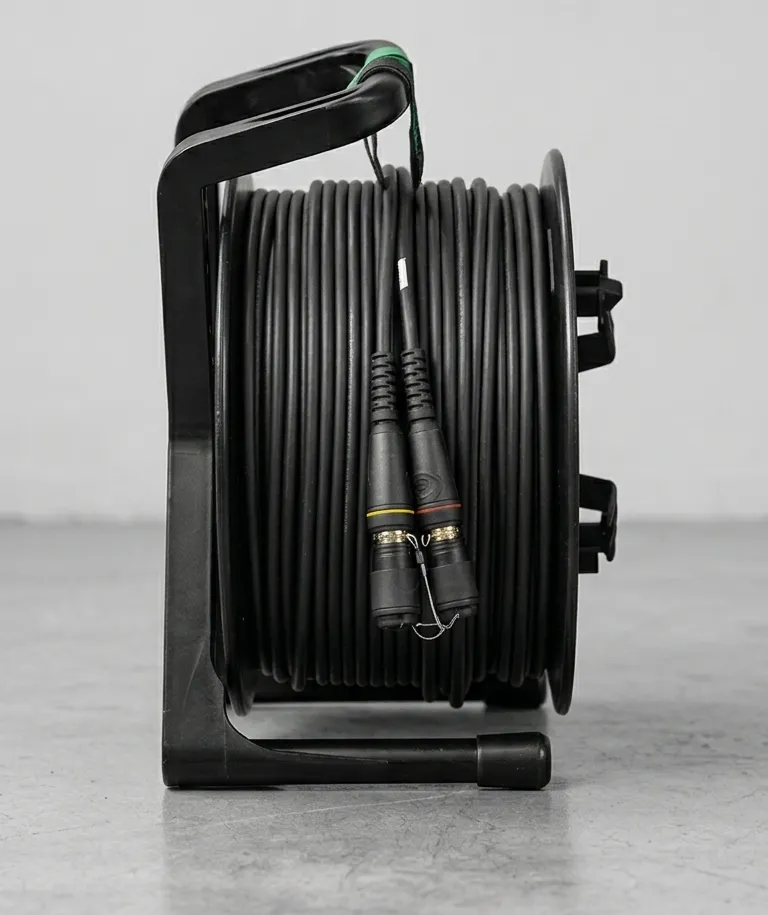
SMPTE Fiber Cable: What You Need to Know for Broadcast Production
If you’ve worked a major sporting event, awards show, or news broadcast in the last two decades, you’ve handled SMPTE fiber cable. It’s the single hybrid cable running from camera head back to the production truck: video, data, power, and comms in one jacket.
It’s also one of the most misunderstood cable types in the industry. People call it “SMPTE cable” without knowing what’s inside, what the standards actually specify, or whether they still need it as IP workflows take over.
What Is SMPTE Fiber Cable?
SMPTE fiber cable is a hybrid fiber-copper cable defined by the SMPTE 311M standard. It combines optical fibers and copper conductors in a single cable assembly, built for connecting broadcast cameras to their base stations or camera control units (CCUs).
Before SMPTE hybrid cable, broadcast cameras needed multiple cables: triax for video, separate power cables, intercom lines, and data connections. SMPTE 311M collapsed all of that into one cable. One connector, one pull, one cable path from camera position to truck.
Belden, Canare, and others manufacture cable to this spec. Camera systems from Sony, Grass Valley, and others use it as their primary camera-to-base connectivity. The standard was built for broadcast production: field deployable, ruggedized for outdoor use, tolerant of repeated connect/disconnect cycles.
For a broader look at fiber in camera systems, see our guide on fiber for broadcast cameras.
Inside a SMPTE Hybrid Cable
A SMPTE 311M cable contains eight conductors in four groups, all within a single outer jacket:
2x Single Mode Fibers (9/125 um) carry the primary video signal. One fiber sends camera video to the base station; the return fiber carries teleprompter feed, return video, or tally data back to the camera. At 9/125 um single mode, these fibers support distances well beyond 10 km.
2x Multimode Fibers (50/125 um or 62.5/125 um) handle auxiliary data, camera control signals, and additional communication channels. They provide bandwidth for bidirectional control data without tying up the single mode pair dedicated to video transport.
2x Copper Power Conductors deliver DC power (typically 48V) from the base station to the camera head. The copper gauge is sized to carry enough current over the cable length without excessive voltage drop. This is what separates SMPTE from pure fiber: the camera doesn’t need a local power source.
2x Copper Signal Pairs carry intercom audio, serial data, and other low-bandwidth signals between camera and base station. Production intercom (RTS, Clear-Com) and engineering talkback typically ride on these pairs.
The assembly is wrapped in a strength member (usually aramid yarn) and an outer jacket rated for field abuse: polyurethane or similar compound that handles repeated flexing, crush loading, and outdoor exposure.
SMPTE Connector Types
The cable is half the story. The connector system is where SMPTE hybrid cable gets complex and expensive.
SMPTE 304M Hybrid Connector
The SMPTE 304M standard defines the original hybrid connector for SMPTE 311M cable. It’s the large, circular, multi-pin connector that mates all four fiber and four copper elements in a single connection, with a positive-locking bayonet mechanism built for repeated field mating cycles.
The connector body is significantly bigger than a standard fiber connector because it aligns four optical fibers and makes four copper connections simultaneously. Termination requires specialized tooling and training. You’re not crimping these in the field with basic equipment.
Lemo 3K.93C
The Lemo 3K.93C is the de facto alternative to SMPTE 304M, especially in European broadcast markets and on many Sony camera systems. Same hybrid fiber-copper complement, smaller form factor.
The 3K.93C uses a push-pull latch instead of the bayonet lock. Many engineers prefer it for faster connection and its smaller size, but the push-pull design can be less secure in high-vibration environments or when cable tension pulls on the connector.
Fischer Connectors
Fischer makes ruggedized hybrid connectors for military broadcast, harsh-environment OB vans, and specialized applications where standard SMPTE or Lemo connectors don’t meet environmental requirements. Fischer connectors offer IP68-rated sealing and higher shock/vibration resistance, but at a significant cost premium.
Connector Maintenance
Every SMPTE connector contains fiber endfaces that need the same cleaning discipline as any fiber optic connection. The difference: a contaminated SMPTE connector costs far more to replace than a standard LC or SC. Inspect and clean before every mate. Use a fiber inspection scope on every connection. A $30 cleaning kit versus a $500+ connector replacement is not a hard call.
SMPTE Cable Performance Specifications
| Parameter | Specification |
|---|---|
| Single Mode Fibers | 2x 9/125 um, ITU-T G.652 |
| Multimode Fibers | 2x 50/125 um (OM3/OM4) or 62.5/125 um |
| SM Attenuation (1310 nm) | ≤ 0.40 dB/km |
| SM Attenuation (1550 nm) | ≤ 0.30 dB/km |
| MM Attenuation (850 nm) | ≤ 3.0 dB/km |
| Power Conductors | 2x 16 AWG (typical) |
| Power Delivery | 48V DC, up to 10A (system dependent) |
| Signal Pairs | 2x twisted pair, 24 AWG (typical) |
| Outer Diameter | 7.5–12.0 mm (varies by manufacturer) |
| Weight | 75–130 kg/km |
| Minimum Bend Radius | 100–150 mm (10-15x OD) |
| Temperature Rating | -40C to +70C |
| Max Recommended Run | 10+ km (fiber limited by optics, copper limited by voltage drop) |
Size and Weight vs Triax
The strongest argument for SMPTE fiber cable over legacy triax is weight and diameter. Standard triax cable (Belden 1858A or equivalent) runs about 12.5 mm OD and 160 kg/km. SMPTE hybrid cable delivers far more bandwidth in a package that weighs 20-50% less and is often smaller in diameter.
On a 500-meter camera run, that means less weight on the pull, smaller cable drums, and more cable in the truck. On a multi-camera production with 8-12 camera positions, the cumulative weight savings add up to hundreds of kilograms.
Bend Radius Considerations
SMPTE hybrid cable has a larger minimum bend radius than pure fiber cable. The copper conductors and the more complex internal structure mean you can’t route it as tightly as standard tactical fiber. Plan for 100-150 mm minimum bend radius depending on the cable, roughly 10-15x the outer diameter. This matters when routing through tight cable troughs or around sharp corners at venue infrastructure.
For runs where you don’t need the hybrid cable’s copper elements, standard single mode fiber is more flexible and easier to route.
SMPTE Cable vs Pure Fiber + Separate Power
This comes up constantly: do you actually need SMPTE hybrid cable, or can you run standard fiber and handle power separately?
When SMPTE Hybrid Makes Sense
Legacy camera systems — If you’re running Sony HDC series, Grass Valley LDX/LDK, or other cameras designed for SMPTE connectivity, hybrid cable is the intended and often required connection method. The camera and CCU expect the full SMPTE complement: fiber for video, copper for power and comms. Fiber-only adapters exist for some systems, but you lose integrated power delivery and often intercom functionality.
Single-cable simplicity — On large multi-camera productions, cable management is a real cost. One cable per camera position is simpler to deploy, label, and troubleshoot than separate fiber, power, and intercom cables per position. The labor savings on a 12-camera sports production add up fast.
Rental and cross-rental compatibility — Rental houses standardize on SMPTE hybrid cable because it works with every major camera system. If you’re renting camera channels, the expectation is SMPTE connectivity. Mixed cable inventories create compatibility headaches.
When Separate Fiber + Power Makes Sense
Long distance runs — SMPTE cable’s copper conductors limit practical power delivery distance due to voltage drop. Beyond 2-3 km, you’re losing significant voltage, and the camera may not get adequate power. Separate fiber plus local power at the camera position solves this. The single mode fibers in SMPTE cable support 10+ km, but the copper can’t keep up.
IP-native camera systems — Newer cameras with direct SDI-over-fiber or IP (ST 2110) outputs don’t need the hybrid cable’s copper elements. A pair of single mode fibers handles video transport. Power comes from a local source or a separate power-over-fiber system.
Cost — SMPTE hybrid cable and connectors are expensive. The cable costs 3-5x more per meter than equivalent tactical single mode fiber. Connectors run $300-800 each, compared to $10-50 for standard LC or opticalCON. For a facility doing primarily fiber-based transport, a large SMPTE cable inventory is a significant capital commitment.
SMPTE Cable in Modern Broadcast Workflows
The broadcast industry is mid-transition from baseband SDI to IP-based transport using SMPTE ST 2110. That has direct implications for hybrid cable’s role going forward.
The IP Transition
ST 2110 separates video, audio, and ancillary data into independent IP streams over standard Ethernet infrastructure. A camera with an ST 2110 output needs standard fiber or copper Ethernet connectivity, not hybrid SMPTE cable. The value of SMPTE 311M (combining multiple signal types in one cable) matters less when everything is IP packets on a single fiber pair.
SMPTE cable won’t disappear overnight. The installed base of SDI cameras is enormous, and the transition to IP is measured in years. But the direction is clear: new facility builds are designing for IP, and video over fiber via standard single mode is the transport layer.
Legacy Camera Systems
Sony HDC-4300, Grass Valley LDX 86N, and similar cameras will be in active service for years. These systems were designed around SMPTE hybrid connectivity and work best with it. Rental houses with large inventories of these cameras will maintain SMPTE cable stocks for the foreseeable future.
If your primary business is supporting these camera systems, SMPTE cable remains essential inventory. The installed base isn’t going away; it’s just not growing.
Rental House Inventory Strategy
Smart rental houses run a dual inventory: SMPTE hybrid cable for legacy camera support, and standard tactical single mode fiber for IP infrastructure, fiber-based SDI transport, and general-purpose connectivity.
The single mode fiber inventory pulls double duty. It handles SDI-over-fiber transport for current workflows and is ready for ST 2110 IP transport as clients transition. SMPTE cable only serves the legacy camera connection use case.
Transitional Deployments
The most common hybrid deployment today uses SMPTE cable for camera connections and standard fiber for everything else. The camera-to-CCU link uses SMPTE 311M because the camera requires it. From the CCU onward (SDI distribution, IP conversion, monitoring) the infrastructure runs on standard single mode fiber.
Practical and economical. You’re not replacing working camera systems to avoid SMPTE cable, but you’re not over-investing in hybrid cable for infrastructure that doesn’t need it.
Making the Right Cable Decision
SMPTE 311M hybrid cable solves a specific problem: single-cable broadcast camera connectivity with integrated power. It does that job well, and it’s been the standard for over two decades.
But it’s not the right cable for every fiber run in a broadcast environment. For SDI transport, IP infrastructure, monitoring distribution, and anything that doesn’t need power delivery over copper, standard single mode tactical fiber is the better choice: lighter, cheaper, more flexible, and ready for IP workflows.
Know what your cameras need. Know what your infrastructure needs. Buy accordingly.