Fiber Optic Cable for Broadcast Cameras: SMPTE, Triax & Camera Fiber Systems
Every broadcast camera beyond about 100 meters from the production truck is running on fiber. Triax still works for shorter distances, but the industry moved to fiber camera systems years ago and isn’t going back. If you’re deploying cameras for festivals, stadium events, concerts, or any remote production with serious distance requirements, fiber is the only cable that makes sense.
This guide covers how camera fiber systems work, what cable types they use, and how to plan fiber deployments for broadcast cameras in the field.
Why Broadcast Cameras Need Fiber
Four factors pushed broadcast cameras from copper to fiber.
Distance
Outdoor broadcast is a distance problem. A festival main stage camera position can sit 500-800 meters from the production compound. A stadium camera at the far end zone might be 400-600 meters from the truck. Triax maxes out around 1,500 meters for SD and drops to roughly 500 meters for HD, and those numbers assume perfect cable with no damage. Single mode fiber handles 10+ km. Distance stops being a factor.
Bandwidth
4K/UHD and HDR signals demand bandwidth that copper can’t deliver over production distances. A single uncompressed 4K signal at 12G-SDI requires 12 Gbps. Add return video for teleprompter, intercom, tally, and camera control data, and you’re moving a lot of bits in both directions. Fiber handles this natively. For a deeper look at SDI transport, see our SDI over fiber guide.
Weight
This matters more than people think. A 500-meter triax run weighs roughly double the equivalent fiber camera cable. On a multi-day festival build where you’re pulling cable across a field and up scaffolding, that weight difference translates directly to labor hours and crew fatigue. SMPTE hybrid fiber cable is lighter than triax for the same distance, and pure fiber is lighter still.
EMI Immunity
Broadcast environments are RF nightmares. LED walls, wireless microphone systems, high-power radio transmitters, lighting dimmers. Copper cable picks up all of it. Fiber doesn’t. Glass is immune to EMI by physics, not by shielding design. In an RF-dense festival or arena environment, that immunity alone justifies fiber.
Camera Fiber Systems Explained
Two main approaches get fiber between a broadcast camera and the production truck: SMPTE hybrid fiber systems and pure fiber systems.
SMPTE 311M Hybrid Fiber Systems
SMPTE 311M defines a hybrid cable that carries everything a camera needs in a single jacket: optical fibers for video and data, plus copper conductors for power, intercom audio, and auxiliary signals. The base station in the truck connects to the camera head via this single hybrid cable and handles format conversion, power supply, and tally/intercom routing.
This is the dominant approach for large-format broadcast cameras from Sony, Grass Valley, and Panasonic. The camera’s fiber adapter (or built-in fiber module) terminates directly to the SMPTE hybrid connector. One cable, one connection, full camera functionality.
Pure Fiber Systems
Some camera systems, particularly newer IP-native designs and lighter production cameras, use pure fiber without copper conductors. Power comes from batteries or local AC at the camera, and everything else travels optically. Evertz and Riedel both make fiber transport systems that convert camera signals to pure fiber for long-haul runs.
Pure fiber is simpler cable, but it means you need local power at every camera position. For permanent stadium installations with power at each camera location, this works well. For temporary festival builds where you’re running everything from the truck, SMPTE hybrid is usually the better call.
Camera-Back Fiber Adapters
Not every camera has a built-in fiber module. Camera-back adapters from Sony, Grass Valley, and third-party manufacturers bolt onto the camera and convert the native camera interface (typically a proprietary multi-pin connector) to SMPTE hybrid fiber. The adapter does the optical-to-electrical conversion and provides the standard SMPTE connector on the cable side.
Signal flow: camera head to camera-back adapter to SMPTE hybrid cable to base station in the truck. The base station outputs standard SDI (or IP) to the production switcher and routes return feeds, tally, and intercom back up the fiber to the camera.
SMPTE Hybrid Fiber Cable
SMPTE hybrid fiber cable is built specifically for broadcast cameras. For a full technical breakdown, see our SMPTE fiber cable guide. Here’s what matters for deployment planning.
What’s Inside
A standard SMPTE 311M hybrid cable contains:
- 2 single mode fibers (OS2, 9/125 um) — primary video transport in both directions
- 2 multimode fibers (OM3 or OM4, 50/125 um) — auxiliary data, camera control
- Copper conductors — DC power delivery to the camera, intercom audio, auxiliary data
All of this sits inside a single rugged jacket, typically with steel armor for field deployment. The cable OD is larger than standard tactical fiber but still lighter and more flexible than triax.
| Specification | SMPTE Hybrid Fiber | Triax (HD) |
|---|---|---|
| Max distance (HD) | 10+ km | ~1,500 m |
| Max distance (4K/UHD) | 10+ km | Not supported |
| Typical cable OD | 9-12 mm | 11-15 mm |
| Weight per 100m | ~8-12 kg | ~15-25 kg |
| Power delivery | Yes (copper conductors) | Yes (center conductor) |
| EMI immunity | Complete (fiber path) | Shielded (copper path) |
| Bidirectional video | Yes | Yes |
| Intercom | Yes | Yes |
Connector Types
Three connector families dominate camera fiber:
SMPTE 304M — The standard SMPTE hybrid connector. Field-proven, widely used on Sony and Grass Valley systems. Carries both optical fibers and electrical contacts in a single mating interface with a positive-lock mechanism.
Lemo 3K.93C — A high-density hybrid connector used extensively in European broadcast and by several camera manufacturers. Compact form factor with good optical performance. Common on Grass Valley LDX and Sony HDC series cameras.
Fischer — Fischer fiber optic connectors appear on some specialized camera systems and military/tactical broadcast equipment. Less common than SMPTE 304M or Lemo in mainstream broadcast but relevant in certain niches.
All three connector types are built for field deployment: repeated mating cycles, outdoor conditions, and the general abuse of broadcast production.
Distance Capability
On single mode fiber, camera systems routinely run 10+ km without any signal degradation. The fiber itself supports far longer distances, but 10 km covers virtually every broadcast scenario. Stadium camera runs of 200-600 meters and festival runs of 300-800 meters are trivial for single mode.
Power Delivery
The copper conductors in SMPTE hybrid cable deliver DC power from the base station to the camera. Typical power delivery is 200-300W, enough to run the camera head, lens servos, and camera-back electronics. No local power needed at camera positions, which matters a lot on temporary builds where running AC power to every camera location gets expensive fast.
Single Mode vs Multimode for Camera Fiber
Inside SMPTE hybrid cable, you’ll find both single mode and multimode fibers. They serve different purposes.
Video signals run on single mode. The primary camera video (program out) and return video (teleprompter, program return) travel on the single mode fibers. Single mode provides the distance and bandwidth for uncompressed HD and 4K video transport. No distance limitation matters in broadcast; single mode handles the full 10+ km range of the system.
Camera control and data can use either. The multimode fibers in SMPTE hybrid cable typically carry camera control data (paint, shading, iris), tally, and auxiliary signals. These are lower-bandwidth signals that work fine on multimode. Some systems use the multimode fibers for diagnostics and system management.
Most modern pure fiber camera systems use single mode exclusively. When you’re not constrained by the SMPTE hybrid standard (which specifies both SM and MM fibers), single mode is the obvious choice. It handles every signal type with plenty of distance headroom. Sony’s latest fiber camera systems and IP-native camera platforms are single mode throughout.
For interconnect fiber between your truck and patch panels, single mode fiber is the right choice. It matches the camera system’s primary transport fiber and gives you maximum flexibility for any signal type.
Deployment for Remote Broadcast
Planning fiber runs for broadcast cameras is different from fixed installations. You’re building temporary infrastructure that has to work on the first try, survive a multi-day event, and strike cleanly.
Typical Distances
- Festival main stage to compound: 300-800 meters. The production compound is typically behind the audience area, and main stage camera positions can be at FOH (front of house), stage wings, or on follow-spot platforms at the rear of the field.
- Stadium camera positions: 200-600 meters. Camera locations span the entire venue — end zones, upper decks, tunnel positions, sideline carts. The production truck is usually in a compound outside the stadium.
- Concert touring: 100-400 meters. Smaller venues with truck access closer to the stage.
Cable Management
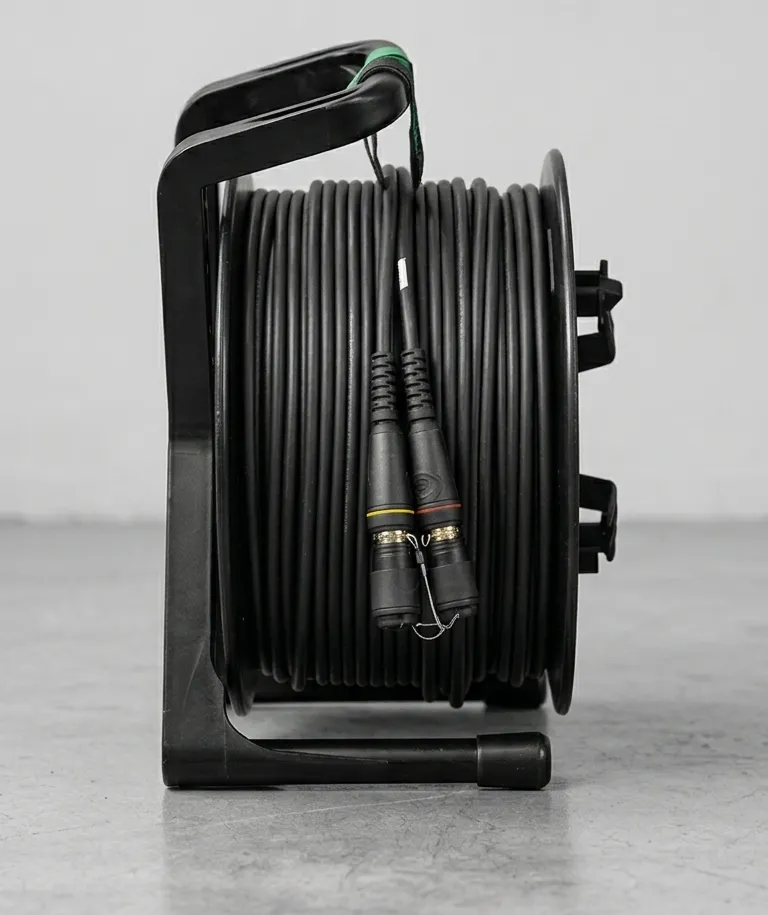
Camera fiber in the field lives on drum reels. Purpose-built fiber reels protect the cable during transport and deployment and allow controlled payout and recovery. Never coil SMPTE hybrid cable in tight loops; the minimum bend radius is larger than standard fiber due to the hybrid construction.
Breakout panels at the truck end let you patch camera fiber runs to the appropriate base stations. A well-organized breakout panel with clear labeling saves real time during setup and troubleshooting. At the camera end, the cable terminates directly to the camera-back adapter or built-in fiber module.
Run cable in protective trays or conduit wherever it crosses vehicle paths or high-traffic areas. SMPTE hybrid cable is tougher than standard patch fiber, but a loaded truck driving over an unprotected cable run will still end your day badly.
Pre-Show Testing
Test every camera fiber run before the show. Period. The testing procedure:
- Visual inspection of all connectors. Look for contamination, cracked ferrules, or damaged housings. Clean every connector face before mating.
- Optical power meter test on each fiber. Verify insertion loss is within spec. A known-good launch cable and power meter is the minimum test kit for camera fiber.
- End-to-end system test. Power up each camera through its fiber run and verify video, return feed, intercom, tally, and camera control all function correctly.
- Label everything. Every cable, every connector, every panel port. When something fails during the show, you need to identify and swap the affected run in minutes, not hours.
For more on fiber testing methodology, see our guide on how to test fiber cable.
The Future: IP-Based Camera Connectivity
The broadcast industry is moving toward IP-based production, and cameras are part of that transition.
SMPTE ST 2110 to Camera
SMPTE ST 2110 defines IP transport for professional media: separate essence streams for video, audio, and ancillary data over standard IP networks. Camera manufacturers are building native ST 2110 outputs into high-end cameras, which means the camera-to-truck connection becomes standard Ethernet over fiber. Sony, Grass Valley, and others already ship cameras with ST 2110 capability.
For cabling, this means camera fiber becomes standard single mode fiber with LC or SC connectors and SFP+ transceivers instead of proprietary SMPTE hybrid cable with specialized connectors. The same tactical fiber cable you use for everything else in your production network works for cameras too.
NDI Over Fiber
For smaller productions and corporate AV, NDI over fiber provides a lighter-weight IP camera workflow. NDI cameras output compressed video over Gigabit Ethernet, which runs cleanly over single mode fiber with media converters or SFP modules. It’s not broadcast-grade uncompressed video, but for corporate events, houses of worship, and streaming productions, NDI over fiber is practical and cost-effective.
When Camera Fiber Becomes Just Ethernet
The direction is obvious: broadcast cameras will be IP endpoints on a fiber network, like everything else in the signal chain. Proprietary camera fiber systems with SMPTE hybrid cable and specialized connectors will give way to standard single mode fiber, standard connectors, and standard network switches.
We’re not there yet. Power delivery over fiber isn’t solved (PoE doesn’t reach broadcast camera power requirements), and the reliability of dedicated point-to-point fiber is hard to match with switched networks. But buying high-quality single mode tactical fiber now means your cable inventory works with both today’s dedicated camera fiber systems and tomorrow’s IP-native cameras.