
How to Choose Fiber Optic Cable for Live Production
Buying fiber optic cable for live production shouldn’t require a telecom engineering degree. But search “fiber optic cable” on any supplier’s site and you’ll hit a wall of specifications, connector types, armor ratings, and fiber grades. Hard to know where to start.
It actually comes down to four decisions. Get those four right and you’ll build an inventory that works across tours, broadcasts, corporate AV, and everything in between. Get them wrong and you’ll buy the same cable twice.
The Four Decisions
Every fiber cable purchase is a combination of four choices:
- Fiber type — single mode or multimode
- Connector type — Neutrik opticalCON DUO, QUAD, or MTP
- Construction tier — Standard Tactical or Super Tactical
- Length and form factor — patch cables, medium runs, or long pulls
The rest of this guide walks through each decision in order, with specific recommendations for production professionals.
Decision 1 — Single Mode or Multimode?
This one affects compatibility with every piece of gear in your signal chain. Single mode and multimode fiber are not interchangeable — different SFPs, different wavelengths, different core sizes.
The short version:
| Scenario | Choose |
|---|---|
| Indoor runs under 300 m | Multimode (OM4) |
| Outdoor runs at any distance | Single mode (OS2) |
| Runs over 300 m | Single mode (OS2) |
| Unknown or varying venue sizes | Single mode (OS2) |
| Dante, AES67, or 1G audio networks | Either — but single mode gives more headroom |
| 12G SDI, SMPTE 2110, high-bandwidth video | Single mode |
Multimode (OM4, 50/125 μm) is the easier choice for short indoor runs. Most 10G SFPs default to multimode. It works for rack-to-rack connections, stage boxes, and any run where you know the distance stays under 300 meters.
Single mode (OS2, 9/125 μm) handles any distance you’ll hit in production — 1 meter to 10 kilometers — without bandwidth limits becoming a factor. The tradeoff: single mode SFPs cost slightly more and the smaller core is less forgiving of dirty connectors.
If you work in one venue and know your longest run is 150 meters, multimode is fine. If you tour, work festivals, or show up to venues you’ve never seen before, buy single mode. You’ll never arrive on site and discover your cable can’t reach.
For the full comparison, read our guide: Single Mode vs Multimode Fiber — Which Do You Need?
Decision 2 — Which Connector?
In production fiber, the connector question is really about Neutrik opticalCON — the rugged, locking fiber connector that’s become the de facto standard on tours and in broadcast. Three opticalCON formats, three different channel densities.
opticalCON DUO (2 Fiber)
The DUO is the workhorse. Two fibers in one connector — one duplex link carrying one video, audio, or data channel. You’ll use this for 80% of production fiber work.
Use DUO for:
- Point-to-point video links (camera to CCU, LED processor to wall)
- Audio-over-IP networks (Dante, AES67, RAVENNA)
- Control data and intercom links
- Rack patching — short jumps between gear
- Any run where one channel per cable is sufficient
DUO matches the most common use case: one link, one cable. It’s also the most widely stocked format, so if you need to borrow or rent cable on a show, DUO is what you’ll find.
opticalCON QUAD (4 Fiber)
Four fibers in one connector — two duplex links in a single cable. Fewer cable runs when you need medium density.
Use QUAD for:
- Multi-channel video (two camera feeds on one cable)
- Redundant paths (primary + backup on the same pull)
- Audio networks where you need more than one link to a location
- Reducing cable count on shows where truss space or conduit is limited
The tradeoff: a QUAD ties four fibers together physically. If you need to route two of those fibers to different locations, you can’t split them without a breakout or patch panel. Touring companies doing the same show layout repeatedly will love QUADs — they save time and truck space. On one-off gigs with unpredictable routing, DUOs give you more options.
opticalCON MTP (12 Fiber)
This is a trunk cable — 12 fibers in one connector, feeding breakout assemblies at distribution points. One MTP run replaces six DUO runs or three QUAD runs.
Use MTP for:
- LED wall distribution (one trunk feeds multiple processors)
- Broadcast compounds with many feeds converging on a single point
- Large-scale fiber infrastructure where cable management matters
- Backbone runs between patch locations
MTP doesn’t replace DUO or QUAD directly. You need a breakout assembly at the far end to split the 12 fibers into individual DUO or QUAD connections. Think of MTP as infrastructure cable — it moves fiber from A to B in bulk, and breakout panels handle the last-meter distribution.
Connector Summary
| Feature | DUO | QUAD | MTP |
|---|---|---|---|
| Fiber count | 2 | 4 | 12 |
| Duplex links per cable | 1 | 2 | 6 |
| IP rating | IP65 | IP65 | IP65 |
| Requires breakout | No | No | Yes |
| Best for | Point-to-point | Multi-channel | Trunk/backbone |
| Relative cost | Lowest | Moderate | Highest |
Decision 3 — Construction Tier
Not all tactical fiber cable is built the same. The armor and jacket construction determines how much abuse a cable takes before the fiber inside breaks. We offer two tiers — which one you need depends on where your cable lives.
Standard Tactical
Standard Tactical cable uses a helical steel wire wrap around the fiber bundle, inside a polyurethane outer jacket. That gives you 800–1,200 N/cm crush resistance — road cases rolling over it, repeated coiling, the general abuse of touring production.
Specs:
- Helical steel wire armor
- 800–1,200 N/cm crush resistance
- Polyurethane outer jacket
- Tighter bend radius (easier to route through tight spaces)
- Lower weight per meter
Good for:
- Touring — load-in, show, load-out, repeat
- Broadcast compounds and OB truck connections
- Indoor production and corporate AV
- Rack patching and short runs
- Any environment where cable isn’t left on the ground under traffic
Standard Tactical is the right call for most production work. The steel armor handles impact and crush forces from normal deployment, and the lighter weight and tighter bend radius make it easier to pull, especially on long runs.
Super Tactical
Super Tactical cable uses a double-layer braided steel armor — the same braiding technique used in military-grade cable. Crush resistance jumps to 1,500 N/cm, with much better protection against repeated crushing and sharp impacts.
Specs:
- Double-layer braided steel armor
- 1,500 N/cm crush resistance
- Polyurethane outer jacket (thicker than Standard)
- Wider bend radius
- Heavier per meter
- Higher cost
Good for:
- Arena floors where forklifts and heavy carts cross cable paths
- Outdoor festivals with vehicle traffic
- Permanent installations in high-traffic areas
- Any environment where cable gets run over repeatedly
- Shows where cable protection (ramps, mats) isn’t practical
The Super Tactical premium is real — heavier, wider bend radius, higher cost per meter. Don’t buy it unless your cable will actually face conditions that exceed Standard Tactical’s limits. If you’re routing through truss, along walls, or in protected pathways, Standard Tactical is plenty.
Construction Tier Summary
| Specification | Standard Tactical | Super Tactical |
|---|---|---|
| Armor type | Helical steel wire | Double braided steel |
| Crush resistance | 800–1,200 N/cm | 1,500 N/cm |
| Typical cable OD (DUO) | 6.2 mm | 7.7 mm |
| Relative weight | Lower | ~25% heavier |
| Bend radius | Tighter | Wider |
| Cost | Standard | Premium |
| Best for | Most production | Harsh environments |
Decision 4 — Length and Form Factor
Cable length is where production experience matters more than spec sheets. The right lengths depend on your venues and your workflow.
Patch Cables (1.5 m, 3 m, 5 m)
Short patches live in racks. They connect SFPs to patch panels, jump between devices in the same rack, and handle the last meter of signal routing. You’ll burn through more of these than you expect.
Buy more patches than you think you need. Every rack needs them, every show uses them, and they’re cheap compared to long runs. Running out of 3-meter patches at a gig is a frustrating, avoidable problem.
Medium Runs (10–50 m)
Medium runs cover stage-to-FOH in small venues, camera positions in corporate AV, and connections between nearby technical areas. These usually live in cable bags or on small reels.
10 m and 25 m are the sweet spot. A 25-meter cable reaches most stage-to-FOH runs in club and theater-sized venues, and a 10-meter cable handles connections between positions that aren’t quite patch-cable distance.
Long Runs (50–300 m)
Long runs are the backbone of your inventory — one end of an arena to the other, OB truck to broadcast compound, FOH to a distant camera position.
50 m and 100 m are the essential long-run lengths. A 50-meter cable handles most arena FOH-to-stage runs. A 100-meter cable reaches across the largest indoor venues and covers most festival stage-to-FOH distances.
For runs over 100 meters, 150 m and 200 m cables handle large outdoor festivals and stadium productions. Over 200 meters, you’re typically in permanent infrastructure territory where cable is installed once and left in place.
Planning Your Lengths
Measure your longest possible run and add 10% for slack. Cable routes around obstacles, goes up and over doorways, follows cable trays, and needs service loops at both ends. A cable that’s exactly the right length on paper is too short in the field.
Run might be 85 meters? Buy a 100-meter cable. Might be 45? Buy a 50. The cost of extra meters is nothing compared to coming up short on show day.
Building Your Cable Inventory
If you’re starting from scratch, here’s the order to build a production fiber inventory:
Phase 1 — Core inventory:
- 2x Standard Tactical DUO, single mode, 50 m
- 2x Standard Tactical DUO, single mode, 100 m
- 2x Standard Tactical DUO, multimode, 50 m
- 2x Standard Tactical DUO, multimode, 100 m
- 6x patch cables (3 m), single mode
- 6x patch cables (3 m), multimode
This covers the most common production scenarios: a pair of long SM runs for distance, a pair of long MM runs for short-haul, and enough patches to connect everything in the rack.
Phase 2 — Fill gaps:
- Add 25 m cables for medium runs
- Add 10 m cables for short hops between positions
- Add more patches (you will always need more patches)
- Add single mode 150 m or 200 m if you work outdoor festivals
Phase 3 — Scale up:
- Add QUAD cables if you consistently run multiple channels to the same location
- Add MTP trunk cables and breakout assemblies for large-scale distribution
- Add Super Tactical versions for specific harsh-environment needs
Common Mistakes to Avoid
Buying all multimode, then showing up to a large venue. A production company buys a full multimode inventory because their regular venues are small, then lands a gig at an arena where the FOH run is 400 meters. Single mode covers every distance. Multimode doesn’t.
Ordering cables too short. A cable that’s exactly the measured distance doesn’t account for routing, service loops, or the time someone moves FOH 10 meters further back. Add 10% slack and round up to the next standard length.
Not buying enough short patch cables. Patches get lost, damaged, and borrowed on every show. Buy twice as many 3-meter and 5-meter patches as you think you need, and replenish them regularly.
Mixing construction tiers without a reason. Pick Standard Tactical as your default and only buy Super Tactical for specific needs. A mixed inventory where some cables are standard and some are super, with no logic behind it, just adds weight and confusion.
Ignoring cleaning and inspection. A $2,000 fiber cable is useless if the connector endface is contaminated. Clean every connector before every mating. Inspect with a fiber scope when troubleshooting. Not a cable selection issue, strictly speaking, but it’s the number one cause of fiber problems in the field.
Frequently Asked Questions
What fiber cable should I buy first?
How do I know what length fiber cable I need?
Standard Tactical or Super Tactical — which do I need?
Summary
Fiber cable selection for production comes down to four decisions, in order:
- Fiber type: Single mode if you tour or work varying venues. Multimode if all your runs are under 300 m indoors.
- Connector: DUO for most work. QUAD for multi-channel runs. MTP for trunk infrastructure.
- Construction: Standard Tactical for 90% of production. Super Tactical for heavy-traffic environments.
- Length: 50 m and 100 m for your core inventory. Patches in bulk. Add 10% slack to every measured run.
Get these four right and your inventory will hold up across venues, show types, and years of production work.
Related Products
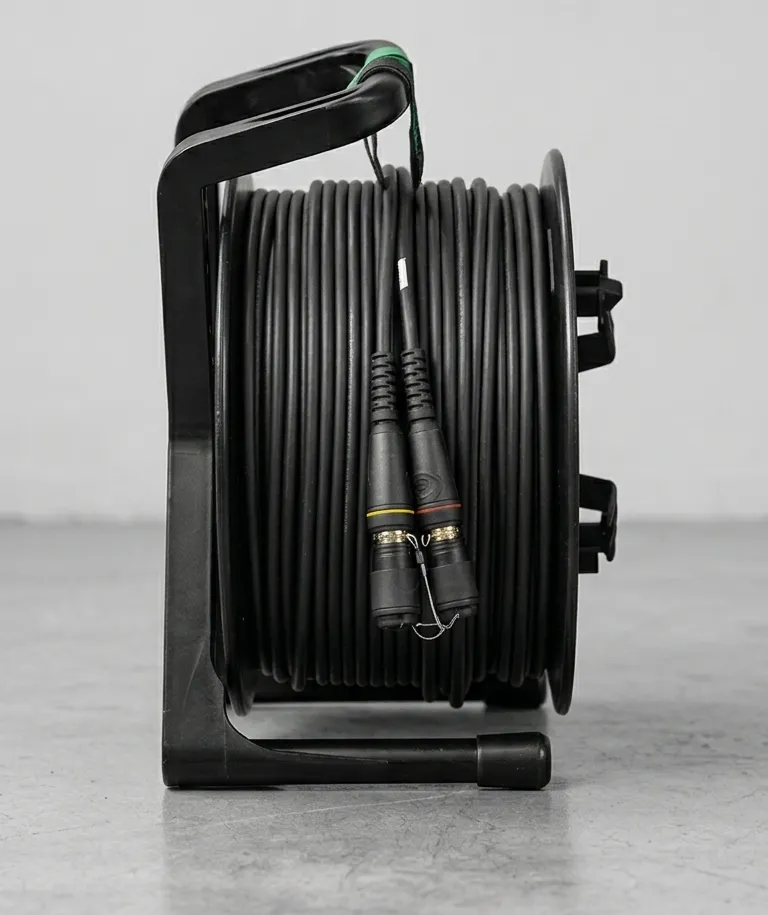
Standard Tactical Fiber Cable — Seetronic SO2MH (opticalCON DUO compatible)
Super Tactical Fiber Cable — Seetronic SO2MH (opticalCON DUO compatible)