Audio Over Fiber: Dante, AES67 & Pro Audio Fiber Networks
Every professional audio network hits the same wall: 100 meters. That’s the maximum segment length for copper Ethernet, and it’s where Dante, AES67, and every other IP-based audio protocol stops working on Cat6. Festival main stage to FOH at 150 meters? Broadcast compound 300 meters from the stadium floor? Corporate campus spread across acres? Copper doesn’t reach.
Fiber solves this. And because Dante and AES67 are standard Ethernet protocols, moving them to fiber is simple. No protocol converters. No format translation. Just Ethernet frames on glass instead of copper.
Why Audio Over Fiber?
Distance is the obvious reason, but there are several others worth knowing.
Distance. Multimode fiber at 1G Ethernet reaches 550 meters (OM3) to 1,000 meters (OM4). Single mode reaches 10+ kilometers. That covers every venue, festival, campus, and broadcast deployment you’ll encounter.
Channel density. A single fiber pair running 1G Ethernet carries up to 512 Dante channels (at 48 kHz) or the equivalent AES67 streams. Two strands of glass replacing hundreds of copper audio pairs. At 10G, you’re into the thousands of channels — more than any single production will need.
EMI immunity. Glass doesn’t conduct electricity. Run fiber alongside dimmer racks, LED walls, RF transmitters, and generator feeds without a second thought. No shielding, no interference, no crosstalk. In broadcast compounds and concert venues where the cable path runs through RF hell, this alone justifies fiber.
Ground loop elimination. Fiber provides complete galvanic isolation between endpoints. Ground potential differences between stage and FOH, the constant source of hum and buzz on analog copper systems, simply don’t apply. The glass doesn’t care what your ground voltage is at either end.
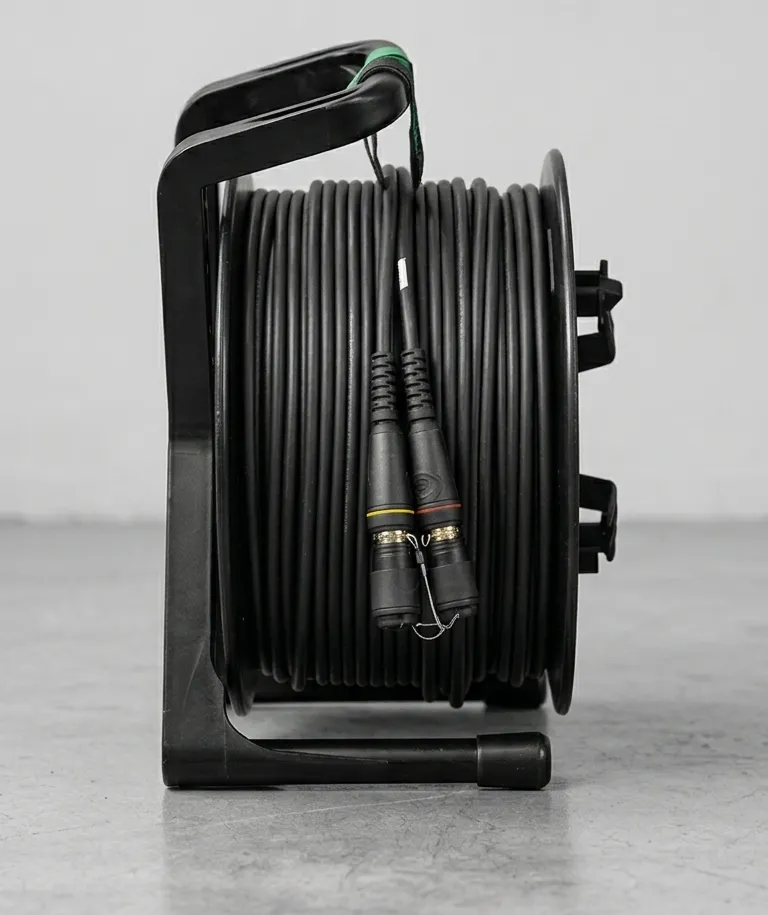
Weight. A 100-meter tactical fiber cable with two fibers weighs a fraction of a copper Cat6 shielded trunk. For touring productions loading trucks every night, that adds up fast.
Dante Over Fiber
Dante is the dominant networked audio protocol in live production. Developed by Audinate, it runs on standard Ethernet. The important thing to understand: Dante doesn’t care whether the Ethernet frames travel on copper or fiber. The protocol is identical. The packets are identical. Only the physical transport layer changes.
How It Works
To run Dante over fiber, you use Ethernet switches with SFP (Small Form-factor Pluggable) ports and install fiber SFP modules. The SFP converts electrical Ethernet signals to optical for transmission over fiber, and back to electrical at the far end. Every Dante device still connects via copper RJ45 to a local switch. The fiber serves as the backbone between switches.
A typical deployment:
- Stage switch (managed, with SFP ports) connects to all stage Dante devices via copper
- Fiber backbone runs from stage switch to FOH switch via tactical fiber cable
- FOH switch (managed, with SFP ports) connects to console, recording interfaces, and local Dante devices via copper
SFP Modules for Dante
Dante runs at 1G Ethernet. You need 1G SFP modules matched to your fiber type:
| SFP Type | Fiber Type | Wavelength | Distance |
|---|---|---|---|
| 1000BASE-SX | Multimode (OM3/OM4) | 850 nm | 550–1,000 m |
| 1000BASE-LX | Single mode (OS2) | 1310 nm | 10 km |
For most venue and touring applications, 1000BASE-SX multimode SFPs paired with OM4 multimode fiber handle everything under 1,000 meters. Beyond that, switch to 1000BASE-LX single mode.
Dante Redundancy on Fiber
Dante supports dual-network redundancy with primary and secondary paths. On fiber, this means running two independent fiber pairs between each switch location, ideally on physically separate cable routes. If one fiber path fails (damaged cable, bad SFP), Dante fails over to the secondary path with no audio interruption.
Audinate’s Brooklyn II and Broadway modules, the chipsets inside most Dante-enabled devices from Yamaha, DiGiCo, and others, support this dual-network architecture natively. Some newer devices with Brooklyn III modules include SFP cages directly on the device, so you don’t need a local copper switch at that endpoint.
AES67 Over Fiber
AES67 is the interoperability standard for networked audio. Where Dante is a proprietary ecosystem (dominant, but proprietary), AES67 defines an open standard that lets devices from different manufacturers exchange audio streams on the same network. Dante itself is AES67-compatible. You can enable AES67 mode on most current Dante devices.
The infrastructure for AES67 over fiber is identical to Dante over fiber. Same switches, same SFPs, same fiber cable. AES67 uses standard Ethernet and IP multicast, so the fiber deployment doesn’t change.
PTP Considerations
AES67 relies on PTP (Precision Time Protocol, IEEE 1588) for clock synchronization between devices. PTP requires that every switch in the network path supports either PTP boundary clock or PTP transparent clock mode. This is a switch firmware feature, not a fiber issue, but it’s the most common point of failure in AES67 deployments.
When building fiber backbones for AES67:
- Use managed switches with verified PTP support (boundary clock preferred)
- Fiber adds negligible latency compared to copper. PTP accuracy is not affected by the transport medium
- Keep switch hop counts low. Every switch adds PTP processing delay
- Equipment from Lawo, Riedel, and Luminex is purpose-built for AES67 with PTP handled correctly out of the box
The switch selection matters more than the fiber selection for AES67 reliability. Get the switching right and the fiber just works.
DMX and Art-Net Over Fiber
Art-Net and sACN (Streaming ACN) are Ethernet-based lighting control protocols. Like Dante and AES67, they ride on standard Ethernet and deploy over fiber via SFP switches with no protocol conversion.
We cover this topic in depth in our dedicated guide: DMX Over Fiber for Lighting Control. The short version: the same fiber backbone you build for audio carries your lighting data simultaneously. Art-Net, sACN, Dante, and AES67 all coexist on the same fiber infrastructure with proper VLAN configuration on your managed switches.
This convergence is one of fiber’s real advantages for production. One fiber trunk from stage to FOH carries your entire show: hundreds of audio channels, thousands of DMX universes, intercom, video control, and network management, all on a single cable pair.
Fiber Network Architecture for Audio
Topology: Star, Not Daisy-Chain
Build your fiber audio network as a star topology where every endpoint switch connects back to a central core switch (or switch pair). Avoid daisy-chaining switches in series. A daisy chain means a single cable failure takes down everything downstream of the break. A star topology isolates failures to the affected link only.
For large deployments (festivals, broadcast centers, arenas), use a spine-and-leaf architecture: core switches at the network center, leaf switches at each stage position and FOH location, all connected via fiber to the core.
Redundant Fiber Paths
Run two fiber cables between every switch pair, primary and secondary, on physically separate routes. If both fibers run in the same cable trunk or conduit, a single forklift incident or truss drop takes out both paths and your redundancy is worthless.
For touring, this means two separate fiber runs from stage to FOH. For permanent installations, route primary and secondary through different conduits or cable trays.
Channel Count Planning
| Link Speed | Dante Channels (48 kHz) | Dante Channels (96 kHz) | Fiber Pairs Needed |
|---|---|---|---|
| 1G Ethernet | 512 | 256 | 1 (+ 1 redundant) |
| 10G Ethernet | 5,120+ | 2,560+ | 1 (+ 1 redundant) |
For the vast majority of live production, 1G Ethernet on a single fiber pair provides more than enough channel capacity. A 512-channel Dante network covers even the largest festival stages with capacity to spare. Only broadcast facilities and very large fixed installations need to consider 10G.
Equipment Selection
Managed Switches
The switch matters more than any other piece of equipment in an audio-over-fiber deployment. Requirements:
- Managed (not unmanaged) — you need IGMP snooping, QoS, VLANs, and for AES67, PTP support
- SFP ports for fiber uplinks (most have a mix of copper RJ45 and SFP slots)
- Non-blocking backplane — the switch must handle wire-speed forwarding without dropping packets
- Low, deterministic latency — audio is real-time; variable-latency switches cause dropouts
Proven switches for production audio networks:
- Luminex GigaCore — purpose-built for AV, preconfigured for Dante/AES67, PTP support, SFP ports standard. The go-to for most production companies.
- Cisco Catalyst and Small Business series — widely deployed, well-documented Dante configuration guides from Audinate. SG350 and CBS350 are popular for smaller deployments.
- Netgear M4250/M4300 — AVB/AES67-certified, ProAV-focused managed switches with SFP+ ports.
Dante Devices
Audinate’s Dante AVIO adapters convert analog or AES3 audio to Dante at the endpoint. These connect via copper to the local switch. The AVIO doesn’t know or care that the backbone is fiber. It just sees an Ethernet network.
Consoles and stage boxes from Yamaha (CL/QL/TF series, Rio stage boxes), DiGiCo (SD-Range, Quantum), and dozens of other manufacturers have Dante built in. All connect via standard Ethernet and work identically whether the backbone is copper or fiber.
AES67 and Intercom
Lawo (V__matrix, A__mic8), Riedel (MediorNet, Artist), and DirectOut (PRODIGY) are the primary AES67 infrastructure manufacturers. Riedel’s MediorNet system includes its own fiber transport with built-in redundancy, giving you a complete fiber audio/video/intercom ecosystem in one platform.
Single Mode vs Multimode for Audio
Most audio-over-fiber deployments run at 1G Ethernet. At 1G, the choice between single mode and multimode comes down to distance:
- Multimode (OM4): Up to 1,000 meters at 1G. Covers virtually every venue, arena, and festival site. Lower-cost SFPs. This is the default choice for production audio.
- Single mode (OS2): Up to 10+ kilometers at 1G. Required for campus networks, large broadcast compounds, and any run exceeding 1 km.
Our recommendation: If your longest run is under 500 meters and you’re only carrying audio, multimode is the practical choice. If any run might exceed 1 km, or if you’re building infrastructure that could carry video (SDI, NDI, SMPTE 2110) in the future, go single mode. Single mode supports every speed at every distance. The cable cost difference is negligible; the SFPs cost more, but you’ll never outgrow the infrastructure.
Frequently Asked Questions
Can Dante run over fiber optic cable?
How many audio channels can fiber carry?
What fiber type do I need for Dante?
Do I need special switches for audio over fiber?
Wrapping Up
Audio over fiber isn’t a specialized technology. It’s standard Ethernet networking with glass instead of copper. Dante, AES67, Art-Net, sACN, and intercom protocols all run natively on fiber without conversion. The infrastructure is straightforward: managed switches with SFP ports, matched SFP modules for your fiber type, and quality tactical fiber cable between locations.
You get a production network that reaches farther, carries more channels, ignores interference, eliminates ground loops, and weighs less than the copper alternative. For any deployment beyond 100 meters, or any environment where EMI and ground issues are a factor, fiber is the right call.